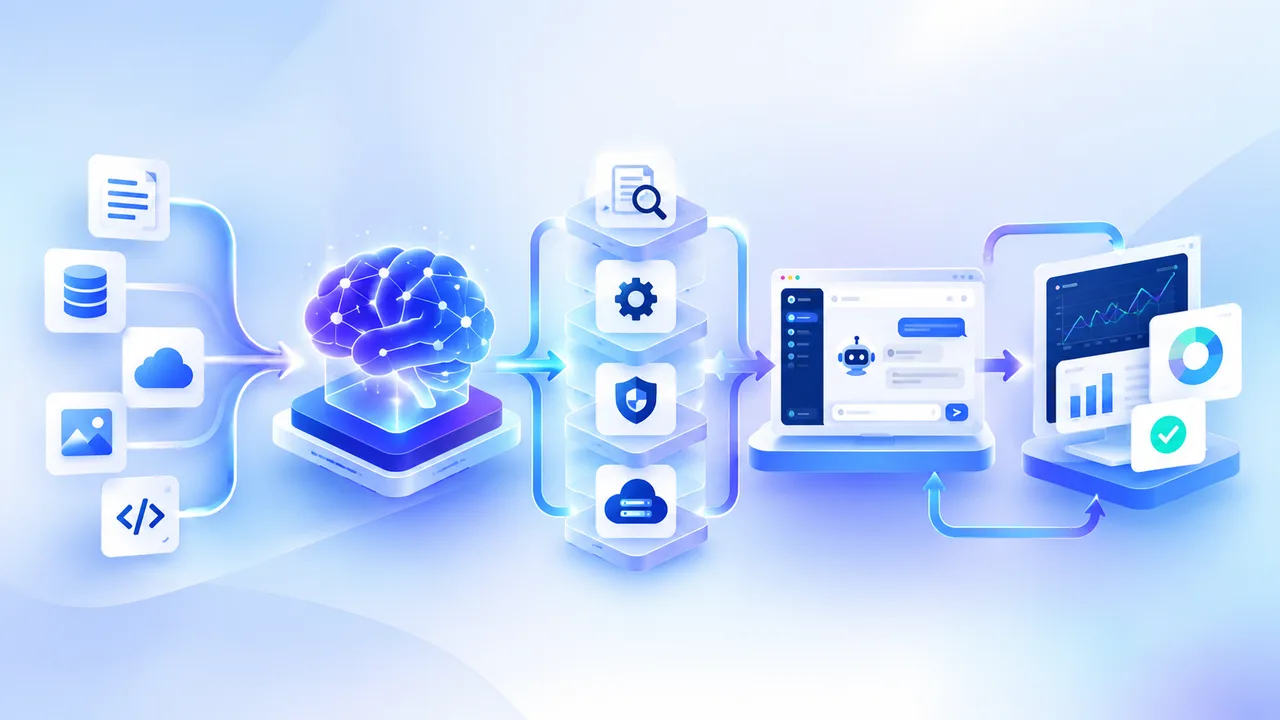
Large Language Models (LLMs) are helping businesses build intelligent applications, automate workflows, and improve user experiences. However, integrating an LLM into a real product requires more than connecting an API.
Businesses need the right model, reliable data, secure architecture, proper testing, and continuous monitoring to make AI useful in production.
This guide covers the key stages of LLM integration, from model selection to production monitoring.
What Are LLM Integration Services?
LLM integration services help businesses connect Large Language Models with applications, enterprise data, APIs, and business workflows.
Common use cases include:
- AI-powered chatbots and virtual assistants
- Enterprise knowledge search
- Document summarization and data extraction
- AI-powered recommendations
- Workflow automation and AI agents
The goal is to integrate AI into existing or new applications while maintaining performance, security, and reliability.
1. Start With the Right Use Case
Before selecting a model, define the problem the application needs to solve.
Identify the business objective, target users, data requirements, accuracy expectations, response time, and budget. These factors help determine the right approach and prevent unnecessary development.
For example, an internal knowledge assistant may need accurate answers from company documents, while a document-processing application may prioritize structured data extraction.
2. Select the Right LLM
Choosing a model involves balancing response quality, cost, latency, security, and deployment requirements.
- Hosted LLM APIs: suitable for teams that want to integrate existing models without managing model infrastructure.
- Open-weight models: offer more deployment control but require additional infrastructure and maintenance.
- Smaller models: can be effective for focused tasks such as classification, routing, and information extraction.
Test shortlisted models against real business scenarios before making a final decision. The best model is the one that meets your application's requirements, not necessarily the largest or most expensive one.
3. Connect the LLM to Business Data
LLMs may need access to company documents, product information, databases, or internal knowledge to provide relevant answers.
Retrieval-Augmented Generation (RAG) retrieves relevant information and supplies it to the model as context. It is useful for enterprise search, knowledge assistants, and document-based applications.
Fine-tuning, on the other hand, can help adapt a model to specific tasks or output patterns. The choice depends on the problem, data, and evaluation results.
Effective AI Integration Services connect models to the right data while maintaining access controls and data quality.
4. Build a Reliable Application Architecture
An LLM is only one part of a production application. The complete system may include:
- Frontend and backend services
- LLM APIs and integration layers
- Databases and retrieval systems
- Authentication and security controls
- Logging, monitoring, and error handling
A well-designed architecture should handle timeouts, API failures, rate limits, and changing workloads. It should also allow teams to update models without unnecessarily changing the entire application.
5. Implement Security and Testing
Security must be part of LLM development from the beginning.
Protect API keys, restrict access to sensitive data, validate model outputs, and test for prompt injection and unauthorized information access.
Before deployment, evaluate response accuracy, latency, cost, and behavior under different inputs. Maintain a test dataset so that changes to prompts, models, or retrieval systems can be checked for regressions.
6. Deploy the Application to Production
Moving beyond a proof of concept requires proper deployment planning.
Teams should establish environment configuration, secure secrets, CI/CD workflows, load testing, rollback procedures, and operational ownership.
A controlled rollout helps identify issues with real users before expanding access. Upperthrust Technologies supports AI Product Engineering Services that bring together application development, LLM integration, testing, and deployment.
7. Monitor LLM Performance in Production
LLM applications require continuous monitoring because response quality, usage, and costs can change over time.
Focus on four areas:
- Performance: response time, errors, availability, and throughput.
- Quality: accuracy, relevance, and grounded responses.
- Cost: token usage, cost per request, and opportunities for optimization.
- Security: suspicious inputs, access failures, and potential data exposure.
Set clear alerts and review recurring failures. Use these insights to improve model selection, prompts, retrieval, and application behavior.
8. Common LLM Integration Mistakes
Avoid these common mistakes when implementing LLM integration services:
- Selecting a model without testing real use cases.
- Using fine-tuning when RAG or better prompting may be sufficient.
- Skipping security and quality evaluations.
- Monitoring infrastructure but ignoring AI response quality.
- Overlooking token usage and operational costs.
- Treating deployment as the final step.
A structured approach helps businesses reduce avoidable risks and build AI applications that are easier to maintain.
Conclusion
Successful LLM integration requires the right combination of model selection, data, application architecture, security, testing, and production monitoring.
Businesses that treat AI as part of the complete product engineering lifecycle are better positioned to move beyond prototypes and build useful, maintainable AI capabilities.
Upperthrust Technologies helps businesses integrate LLMs into new and existing products through AI Integration Services, Generative AI Development, RAG Development, and AI Product Engineering Services.
Planning to integrate LLMs into your product? Get in touch with Upperthrust Technologies to discuss your requirements.
Book a free 30-minute consultation with our engineering leads.